Alright, Tripsora fam, let’s talk about that moment. You know the one. You’re scrolling through your feed, minding your own business, when BAM! A photo pops up that makes you do a double-take. Your brain immediately screams, "Photoshop!" because what you’re seeing is just too perfect, too vibrant, too… unreal. But then you read the caption, and it hits you: "No filter needed." "This is real life." And suddenly, a new, insatiable itch starts to form – the urge to see it with your own eyes, to stand in that impossible landscape, and to capture that mind-bending shot for yourself.
I’ve been there. More times than I can count. My first encounter with this phenomenon was an image of Bolivia's Uyuni Salt Flat. It looked like someone had merged a cloudscape with an endless lake. I refused to believe it was real until I saw a video, then booked my ticket faster than you can say "perspective shot." And let me tell you, standing there, with the horizon dissolved into a perfect reflection, feeling like I was walking on the sky itself, was one of the most profoundly surreal experiences of my life. It changed how I saw the world, and more importantly, it ignited a quest: to find and photograph more of these "fake but real" places before I kick the bucket.
So, buckle up, buttercups! Because today, we’re embarking on a virtual journey to some of the planet’s most visually deceptive, utterly mind-blowing photo spots. These aren't just pretty places; they're natural wonders that challenge your perception, make you question reality, and promise the kind of photos that will make your followers think you've mastered advanced digital art (or discovered a portal to another dimension). Get your cameras ready, because these are the places you need to experience before you die.
1. Salar de Uyuni, Bolivia: Walking on the Sky
Let’s kick things off with my personal gateway drug to the fake-but-real world: the Salar de Uyuni. This isn't just the world's largest salt flat; it's a colossal, shimmering expanse that transforms into the planet's most epic mirror during the rainy season (roughly December to April).
- Why it looks fake: Imagine an endless, blindingly white canvas that, when covered by a few inches of water, perfectly reflects the sky above. The horizon disappears, and you literally feel like you're walking on clouds, suspended between two infinite blues. During the dry season, the hexagonal patterns in the salt crust stretch to the horizon, making it look like an alien landscape, a giant tiled floor laid out by some cosmic architect.
- My experience: I remember my first morning there, bleary-eyed from the altitude, stepping out of our jeep into what felt like a dream. The air was crisp, the silence profound, and the sky above was duplicated perfectly beneath my feet. Our guide had us take perspective shots – me "holding up" the jeep, my friend "drinking" from a giant bottle – and each one looked so utterly impossible, it was pure joy. The sunsets here are otherworldly, painting the reflective surface with fiery oranges and purples that stretch into infinity.
- Getting the shot: For the iconic mirror effect, you must visit during the rainy season. A wide-angle lens is your best friend here, capturing the vastness and the perfect reflections. Get low to the ground for maximum mirror effect. Don't be afraid to experiment with props (toy dinosaurs, giant sunglasses, empty water bottles) for those classic perspective shots – the flat, featureless landscape makes them incredibly convincing. Golden hour and sunset are prime for dramatic skies.
- Practicalities: Most tours depart from Uyuni (3-day/2-night tours are popular, costing around $150-250 USD, including food and basic accommodation). Be prepared for high altitude (over 3,600m / 12,000 ft) and varying temperatures. Pack layers, sun protection (the glare is intense!), and plenty of water. Bolivia is surprisingly affordable, but cash is king, especially in remote areas.
2. Las Coloradas, Yucatán, Mexico: The Pink Sea of Salt
Imagine a body of water so vibrantly pink it looks like a giant strawberry milkshake or a scene from a Wes Anderson movie. Welcome to Las Coloradas, a series of salt evaporation ponds on Mexico’s Yucatán Peninsula, where the water is naturally tinted a breathtaking shade of bubblegum.
- Why it looks fake: The color is so intense and uniform that it seems entirely artificial. It’s hard to believe nature could produce such a hue without human intervention. The bright pink water contrasting with the white salt mounds (which look like snowdrifts!) and the azure sky is a visual feast that screams "edited!"
- My experience: After a long drive from Mérida, the first glimpse of the pink lake through the palms was genuinely gasp-inducing. My jaw literally dropped. It was even more vibrant than any photo I'd seen. I spent an hour just walking along the edge, mesmerized by the color, watching the local salt workers, and trying to capture the impossible beauty. It felt like stepping onto another planet, or perhaps into a giant, sugary dessert.
- Getting the shot: The best time for the most intense pink is on a sunny day, ideally around midday when the sun is directly overhead, intensifying the color. Use a drone if you have one – the aerial views are spectacular. Wear contrasting colors (white, blue) to really pop against the pink. Remember, you can't swim in the lakes as they are active salt production sites, but the visual alone is worth the trip.
- Practicalities: Las Coloradas is located about 3 hours east of Mérida or 3.5 hours west of Cancún. A rental car offers the most flexibility, though tours are available. There’s a small entrance fee (around $5-10 USD) which often includes a local guide who can explain the salt production process. Pair it with a visit to Río Lagartos for a flamingo tour!
3. Zhangye Danxia Landform Geological Park, China: The Rainbow Mountains
Prepare to have your perception of mountains shattered. In China's Gansu province, the Zhangye Danxia Landform Geological Park presents a landscape so vividly striped and colored, it looks like a colossal painting brought to life. These aren't just hills; they're geological masterpieces.
- Why it looks fake: The mountains are striped with dramatic bands of reds, yellows, oranges, greens, and blues, looking like layers of a giant, multi-colored cake. The perfectly defined lines and vibrant hues make it seem like an artist meticulously painted each ridge. It simply doesn't look like natural rock formations.
- My experience: Walking along the wooden boardwalks, taking in the panoramic views, I felt utterly dwarfed by the sheer scale and artistry of nature. Each viewpoint offered a new, more breathtaking perspective. The colors shifted with the light, deepening and intensifying, making the landscape feel alive. It was humbling to stand before something so ancient yet so vibrantly alive. I remember feeling a childish urge to run my hands over the "paint" to see if it was real.
- Getting the shot: Wide-angle lenses are essential to capture the sprawling grandeur. Sunset and sunrise are magical times, as the low-angle light dramatically enhances the colors and shadows, making the layers pop even more. Experiment with panoramas. The park has well-maintained viewing platforms, so you’ll have plenty of opportunities for incredible shots.
- Practicalities: The park is near the city of Zhangye. You can fly to Lanzhou or Xining and then take a high-speed train to Zhangye. From Zhangye, local buses or taxis can take you to the park. The entrance fee is around $30-40 USD, which includes shuttle bus service between the various viewpoints. Best times to visit are June-September or October-November.
4. Antelope Canyon, Arizona, USA: Sculpted Light and Stone
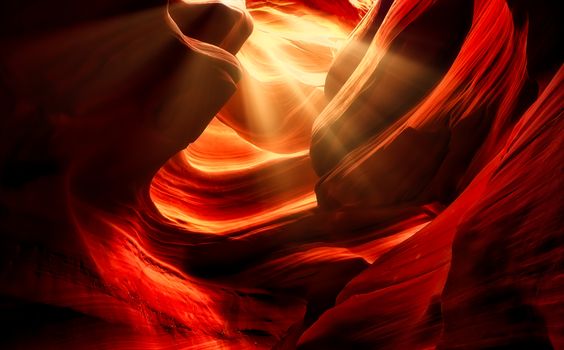
Step into Antelope Canyon, and you'll immediately understand why it's a photographer's dream. This slot canyon, carved by millennia of water and wind, features swirling, smooth sandstone walls that glow with ethereal light beams, making it feel less like a cave and more like a digital rendering or an alien cathedral.
- Why it looks fake: The perfectly smooth, flowing curves of the sandstone, the way the light filters down in solid, almost tangible beams, and the vibrant oranges, reds, and purples that shift with the sun's position – it all looks too perfect, too sculpted, too otherworldly to be real. It truly feels like you’ve stepped inside a giant, liquid rock formation.
- My experience: The moment I stepped into Lower Antelope Canyon, the heat of the Arizona desert vanished, replaced by a cool, quiet reverence. The light played tricks, making the walls seem to breathe and flow. I found myself constantly looking up, mesmerized by the slivers of sky and the way the light danced. In Upper Antelope, seeing those famous light beams pierce the darkness, illuminating the dust motes like glitter, was pure magic – a moment of natural theater.
- Getting the shot: For the iconic light beams in Upper Antelope Canyon, visit between late spring and early fall, ideally around midday. Lower Antelope offers more intricate curves and is generally less crowded. Photography tours are often available and can give you slightly more time. A wide-angle lens is crucial. High ISO will be your friend in the dim light. Tripods are often restricted in Upper Canyon due to crowds, so practice your handheld stability.
- Practicalities: Both Upper and Lower Antelope Canyons are on Navajo land, and you must visit with a certified Navajo guide. Book tours well in advance, especially during peak season. Tours typically cost between $80-150 USD per person. Page, Arizona, is the nearest town and serves as a great base for exploring.
5. Hitachi Seaside Park, Japan: Fields of Color
Japan is known for its meticulous gardens, but Hitachi Seaside Park takes it to an entirely new level. Here, vast, rolling hills are blanketed with a single type of flower or plant, creating breathtaking, monochromatic landscapes that look like something out of a hyper-realistic painting or a video game.
- Why it looks fake: Imagine an entire hill covered in millions of tiny, perfectly spherical, bright red Kochia plants in autumn, or an endless sea of delicate blue Nemophila flowers in spring. The sheer scale and uniformity of the color are so perfect, so impossibly vibrant, that it feels manufactured. It's too beautiful to be real.
- My experience: My visit during autumn, when the Kochia plants turn a fiery crimson, was an unforgettable explosion of color. Walking through the pathways, surrounded by these perfectly shaped, glowing red bushes, felt like being immersed in a dream. The contrast with the blue sky and the distant Ferris wheel was stunning. The Japanese attention to detail in maintaining such a vast, natural canvas is truly remarkable.
- Getting the shot: Capture the vastness with a wide-angle lens, or use a drone for incredible aerial perspectives. Get down low to emphasize the expanse of color, or use the Ferris wheel in the background for scale. The light around sunrise and sunset can add a beautiful soft glow.
- Practicalities: Hitachi Seaside Park is located in Hitachinaka, Ibaraki Prefecture. It's easily accessible by train from Tokyo (take the JR Joban Line to Katsuta Station, then a short bus ride). Entrance fees are modest, around $5-10 USD. The best times to visit are mid-April to May for Nemophila (blue flowers) and mid-September to mid-October for Kochia (red plants). Check their website for bloom forecasts!
6. The Wave, Arizona, USA: Nature's Liquid Art
This isn't just a rock formation; it's a masterpiece of geological art, a swirling, psychedelic sandstone canvas that genuinely looks like frozen liquid. The Wave, located in the Paria Canyon-Vermilion Cliffs Wilderness, is so surreal that seeing it feels like stepping into a giant, abstract painting.
- Why it looks fake: The smooth, undulating curves and vibrant, contrasting stripes of orange, red, pink, and white sandstone create an optical illusion of fluidity. It looks like a massive wave has been perfectly frozen in time, or like a giant has poured layers of colored sand and let them swirl into intricate patterns.
- My experience: Securing a permit for The Wave is notoriously difficult (more on that in a moment), so the anticipation leading up to my visit was immense. The hike in was challenging but beautiful, building to the moment I first laid eyes on The Wave. It was even more spectacular than the photos. The silence, the ancient beauty, the feeling of being in such an exclusive, untouched place – it was truly profound. I spent hours just walking its contours, marveling at every curve and color shift.
- Getting the shot: A wide-angle lens is essential to capture the sweeping curves. The light changes throughout the day, altering the shadows and colors, so take your time. Early morning or late afternoon light can bring out the most dramatic contrasts. Look for leading lines and unique angles.
- Practicalities: This is perhaps the most challenging spot on this list due to extremely limited access. Only 20 permits are issued per day (10 online lottery, 10 walk-in lottery in Kanab, Utah). Apply months in advance for the online lottery, or try your luck in person. The hike to The Wave is strenuous (6.4 miles round trip) and unmarked, requiring good navigation skills. There are no facilities, so bring all your water and supplies. The permit is around $7 USD. Its exclusivity makes it even more "fake but real" and sought after.
7. Fly Geyser, Nevada, USA: The Accidental Alien Spring
Our final stop is a little different, a bizarre, multi-colored geyser that looks like something from another planet, or perhaps a prop from a sci-fi movie. The kicker? It's entirely man-made, an accidental creation that has grown into a truly surreal natural wonder.
- Why it looks fake: This isn't your typical geyser. It's a series of mineral-laden mounds, constantly spouting hot water, covered in vibrant red and green algae that give it an alien, almost sculptural appearance. The colors are so intense, and the form so unusual, that it’s hard to believe it just… emerged.
- My experience: I stumbled upon photos of Fly Geyser years ago and was convinced it was a digital artwork. When I learned it was real, and accidentally formed from a drilling mishap, my mind was truly blown. Getting to see it in person, tucked away in the Nevada desert, was like discovering a secret portal. The constant hiss of the water, the steam rising, and the vibrant, almost fluorescent colors against the stark desert landscape felt like a scene from an otherworldly dream. It's a testament to nature's ability to reclaim and transform, even from human error.
- Getting the shot: Wide-angle shots are great for capturing the entire, bizarre structure. Get close (respectfully!) to capture the intricate mineral deposits and the vibrant algae. Drone shots offer a fantastic perspective, though be aware of any drone restrictions. The steam and mist can add a dramatic effect to your photos.
- Practicalities: Fly Geyser is located on private property, Fly Ranch, which is now owned by the Burning Man Project. Access is highly restricted and not open to the general public for casual visits. You might be able to visit through specific guided tours or events organized by Fly Ranch/Burning Man Project. Check their official website for current access information. It's not a spot you can just drive up to, which adds to its mystique and "fake but real" allure. If you do manage to visit, treat the land with utmost respect.
Essential Tips for Capturing the Unreal
- Do your research: Each location has specific best times to visit (e.g., rainy season for Uyuni, specific bloom times for Hitachi). This is crucial for getting the shot.
- Pack the right gear: A wide-angle lens is almost mandatory for capturing the scale of these places. A tripod is invaluable for low-light conditions or long exposures (where permitted). Don't forget extra batteries, memory cards, and a power bank.
- Respect the environment: These are natural wonders. Stick to marked paths, don't leave any trace, and respect local regulations and cultures. For places like The Wave, permits are for preservation.
- Embrace the elements: Many of these spots are remote. Be prepared for varying weather, altitude, and rustic conditions. Layers, sturdy shoes, and sun protection are key.
- Look beyond the obvious: While the iconic shots are great, challenge yourself to find unique angles, focus on details, or capture the human element interacting with these incredible landscapes.
- Go with an open mind: The "fake but real" magic is as much about the experience as the photo. Let yourself be awestruck.
The World is More Amazing Than You Think
These places are more than just Instagram backdrops; they are testaments to the incredible artistry of our planet, reminders that reality can often be stranger and more beautiful than fiction. They push the boundaries of what we think is possible, urging us to explore, to question, and to truly see the world around us.
So, which of these mind-bending spots are you adding to your bucket list first? Will you walk on the sky in Bolivia, or get lost in the rainbow mountains of China? Perhaps you'll chase the elusive permit to The Wave, or marvel at Japan's fields of color. Whatever your choice, get ready for an adventure that will challenge your perceptions and fill your feed with photos that will make everyone else do a double-take.
Share your dream photo op in the comments below, and don't forget to tag us in your unbelievable adventures! #TripsoraFakeButReal #UnrealTravel #BucketListPhotos
---