The Hook: When the East Sea Stole the Caribbean’s Clothes
I stepped off the wooden outrigger boat and immediately lost my balance—not because of the swells, but because my brain flatly refused to process the color of the water.
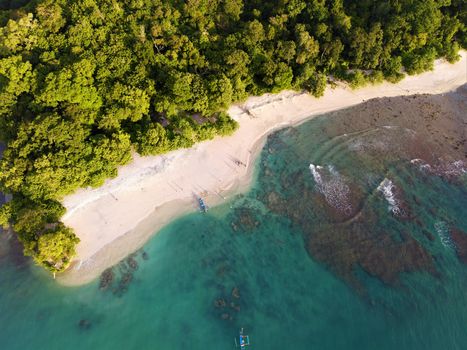
The air smelled of two-stroke outboard engine exhaust, briny sea spray, and charred pork skewers sizzling over coconut shells on a rusted steel drum fifty yards down the beach. Under my bare feet, the sand didn’t crunch; it yielded with the silken, floury give of sifted powdered sugar. The water wasn’t merely clear—it was a neon, hyper-saturated cyan so incandescent that it cast shimmering blue reflections onto the hulls of passing traditional bancas.
If you had blindfolded me, dropped me onto this blinding sandbar, and told me I was standing in the Exuma Cays in the Bahamas or off the coast of Virgin Gorda, I would have handed you a twenty-dollar bill and asked for a rum punch without a second thought.
Except I wasn't in the West Indies. I was in Balabac, at the extreme southwestern fringe of Palawan, just a stone's throw from Malaysian Borneo.
For decades, the Caribbean has held the monopoly on barefoot luxury, sugar-white sandbars, and luminous, glass-bottom clarity. But soaring flight costs, mega-resort development, and suffocating cruise crowds have driven seasoned wanderers to seek that pristine, deserted-island high elsewhere. This year, an emerging wave of coastal gems across Asia is delivering those exact postcard-perfect Caribbean visuals—untouched coral flats, rustling coconut groves, and blindingly turquoise seas—minus the $900-a-night resort markups.
Pack your dry bag. These are the Asian beaches that feel like the Caribbean emerging this year, and they are worth every single mile of transit.
---
1. Balabac, Palawan (Philippines): The Exumas of Southeast Asia
If the sandbars of the Exumas in the Bahamas keep you up at night, Balabac will feel like a spiritual awakening. Suspended in the Sulu Sea at the southernmost tip of Palawan, this 31-island archipelago has remained shielded from mass tourism by sheer geographic isolation and local conservation efforts.
```
[Balabac Sandbar Profile]
Low Tide: ~~~~~~~~~~~~~~~~~~~~~~~~~~~~ (Open Sea)
\ [Blinding White] /
\____ Pure Talc Sand ___/
\_______________/
```
The crown jewel is Onok Island, an impossibly vivid private atoll surrounded by a shallow platform of luminescent aquamarine water where wild green sea turtles graze on sea grass beds right beside you. Nearby, the Mansalangan Sandbar stretches for over a kilometer during low tide, unrolling an expanse of calcium-carbonate sand that leaves you stranded in ankle-deep, lukewarm crystal water with not a high-rise resort in sight.
- The Caribbean Twin: Great Exuma & Big Major Cay, Bahamas.
- Local Flavor: Freshly grilled needlefish brushed with banana ketchup and crushed calamansi lime, served on a banana leaf alongside sticky garlic rice.
- Pro-Tip: Book your private expedition via a local operator registered in Puerto Princesa at least two months in advance. Request a vessel with an auxiliary shade canopy—the solar refraction off these sandbars will fry unprotected skin in under twenty minutes.
---
2. Koh Kood (Thailand): The St. John of the Gulf of Thailand
While Phuket and Koh Samui long ago surrendered to neon beach clubs and mega-chains, Koh Kood quietly held onto the slow, intoxicating rhythm of the American Virgin Islands circa 1974. Located in the eastern Gulf of Thailand near the Cambodian marine border, Koh Kood is draped in thick old-growth rainforest that tumbles down red-dirt hillsides directly into calm, crystalline lagoons.
Head to Ao Tapao Beach or the secluded crescent of Bang Bao Bay. The water here isn’t the deep navy of the open ocean; it is a pale, Caribbean mint-green, framed by ancient coconut palms that lean over the high-tide line at gravity-defying angles. You won't find jet skis screaming across the horizon or beach hawkers selling counterfeit sunglasses. Instead, you get low-slung timber piers stretching out over water so transparent you can count the stripes on the damselfish from fifteen feet above.
- The Caribbean Twin: St. John, U.S. Virgin Islands.
- Local Flavor: Massaman curry simmered with local baby potatoes, whole roasted peanuts, and rich hand-pressed coconut cream that coats the back of your spoon.
- Pro-Tip: Rent a 125cc semi-automatic scooter at the pier for $7 a day to navigate the island’s steep, winding central concrete spine. Make the trek out to Klong Chao Waterfall early at 7:45 AM; you’ll have the freshwater jungle swimming hole entirely to yourself before the day-trippers arrive.
---
3. Belitung Island (Indonesia): The Virgin Gorda of the Java Sea
There are only a handful of places on Earth where massive, sea-sculpted granite monoliths rise directly out of warm, turquoise ocean water. For years, travelers thought you had to sail to "The Baths" in Virgin Gorda to walk between these smooth, prehistoric giant boulders.
Belitung proves otherwise.
Situated off the east coast of Sumatra, Belitung’s Tanjung Tinggi Beach features granite formations soaring up to thirty feet high, creating sheltered, natural saltwater pools that look completely unreal against the white sand and neon sea. At nearby Pulau Lengkuas, a working Dutch colonial lighthouse built in 1882 towers over a halo of fringing coral reefs that rival anything found in the British Virgin Islands.
- The Caribbean Twin: Virgin Gorda, British Virgin Islands.
- Local Flavor: Mie Belitung—chewy yellow noodles bathed in a sweet, savory broth infused with dried shrimp, boiled potatoes, and fried shallots, served hot inside a waxy brown paper wrap.
- Pro-Tip: The secret passage to the quietest swimming cove at Tanjung Tinggi is reached by ducking beneath the split boulder just left of the primary parking area. Walk twenty paces through the rock corridor to access a wind-protected cove that the tour groups overlook.
---
4. Dam Trau Beach, Con Dao Islands (Vietnam): The St. Barths of Indochina
The Con Dao archipelago spent decades shrouded in grim historical isolation as a former penal colony. That remote history inadvertently saved its pristine marine environment from overdevelopment. Today, the islands exude the refined, wild beauty of St. Barths before the private jets moved in.
Tucked along the northwestern rim of the main island, Dam Trau Beach is cradled by red-stone headlands and backed by stands of tropical almond and pine trees. The sand has a unique, warm golden hue reminiscent of French Caribbean coves, and the surf breaks gently over soft, shallow banks. Adding a dramatic, St. Maarten-style thrill, landing commercial turboprops skim directly over the tree line on their final approach to the adjacent airstrip, making for an unforgettable sight while floating on your back in 82-degree water.
- The Caribbean Twin: Anse de Grande Saline, St. Barths (with a touch of Maho Beach, St. Maarten).
- Local Flavor: Fresh squid flash-fried with whole green peppercorns harvested locally from the mountain slopes, dipped in coarse sea salt and cracked lime juice.
- Pro-Tip: Head to the far eastern end of Dam Trau at low tide. Scramble over the smoothed granite rocks (wear water shoes) to enter Secret Beach (Bai Nhat), a micro-bay flanked by cliffs that offers exceptional snorkeling right off the shore.
---
5. Taketomi Island, Okinawa (Japan): Turks & Caicos with Ryukyu Soul
Most travelers picture sub-zero powder skiing when thinking of Japan. Yet the Yaeyama Islands—anchored 1,200 miles south of Tokyo in the subtropical East China Sea—share the exact latitude of the Bahamas.
Taketomi Island
is a tiny, circular coral island ringed with broad, brilliant white sandbars and luminous shallow flats that match the Turks and Caicos point for point. At Kondoi Beach, the tide recedes to reveal vast, shallow lagoons where the water is as warm as a bath and so transparent that small waterbirds appear to be walking on air. The island itself is preserved as an architectural heritage site: coral stone walls, red-tiled Ryukyu roofs crowned with guardian shisa lions, and sand streets traversed only by water buffalo carts.
- The Caribbean Twin: Grace Bay, Turks and Caicos.
- Local Flavor: Yaeyama Soba with thick wheat noodles in a clear, rich broth made from simmered pork bone and dried bonito flakes, topped with marinated pork belly and local pipaatsu island pepper.
- Pro-Tip: Avoid taking the midday return ferry back to Ishigaki. Stay the night at an authentic family-run minshuku (guesthouse). When the final day-tripper boat departs at 5:00 PM, the island falls completely silent, and the stargazing at Kondoi Beach is world-class due to the absence of streetlights.
---
6. Lazy Beach, Koh Rong Sanloem (Cambodia): Isla Holbox Without the Golf Carts
While party-seeking backpackers converge on Koh Rong, its southern sibling, Koh Rong Sanloem, offers the mellow, laid-back Caribbean energy of Mexico's Isla Holbox or Jamaica’s Treasure Beach.
Cut off from roads, cars, and concrete infrastructure, the island's premier retreat is Lazy Beach, set in a sheltered western bay reachable only by boat or an adventurous 40-minute hike through a jungle trail. The sand here is remarkably soft and deep, meeting a tranquil sea that transforms through shades of jade, periwinkle, and turquoise as the sun tracks across the sky. At night, the lack of light pollution causes the waterline to glow with bright fields of bioluminescent plankton—every step you take into the surf kicks up underwater constellations.
- The Caribbean Twin: Isla Holbox, Mexico / Little Corn Island, Nicaragua.
- Local Flavor: Steamed blue swimmer crab cracked fresh at the table, slathered in a fiery sauce of crushed Kampot green peppercorns, palm sugar, and garlic.
- Pro-Tip: Don't attempt the jungle path across from Saracen Bay with rolling luggage. Pack everything in a weather-resistant rucksack or hire a local longtail boat from the main pier to deliver you straight onto the Lazy Beach sand.
---
The Logistics Blueprint: How to Pull It Off
Trading the Caribbean for emerging Asia requires slightly more flight time, but your daily spending plummets dramatically once your feet hit the sand.
| Destination | Best Travel Window | Flight Gateway | Transfer Method | Avg. Daily Budget (USD) |
| :--- | :--- | :--- | :--- | :--- |
| Balabac, Palawan | Nov – May | Puerto Princesa (PPS) | 5-hr van + 2-hr chartered outrigger | $45 – $75 (All-inclusive tour) |
| Koh Kood, Thailand | Nov – April | Trat Airport (TDX) | 45-min catamaran transfer | $50 – $120 (Boutique resort) |
| Belitung, Indonesia | April – Oct | Jakarta (CGK) | 55-min domestic flight | $40 – $90 (Mid-range villa) |
| Con Dao, Vietnam | March – Sept | Ho Chi Minh (SGN) | 45-min turboprop flight | $60 – $150 (Oceanfront stay) |
| Taketomi, Japan | May – Oct | Ishigaki (ISG) | 10-min high-speed ferry | $90 – $180 (Traditional stay) |
| Koh Rong Sanloem | Dec – April | Sihanoukville (KOS) | 45-min express speedboat | $35 – $80 (Beach bungalow) |
Why This Shift Is Accelerating
The shift toward these emerging Asian coastlines isn't just about saving money; it’s about rediscovering genuine discovery. In places like Balabac and Belitung, you won’t encounter lines for sunset photo ops or $35 poolside cocktails. You find authentic coastal villages, healthy fringing reefs, and that rare, precious sensation of having stumbled upon an untouched paradise before the rest of the world caught on.
*