The Underground Call: Why Half-Day Speleology is Travel’s Best Kept Secret
I stepped out of the humid 92°F Kentucky sun, ducked past the concrete lip of the Historic Entrance, and felt the ambient air drop instantly to a crisp, damp 54°F. The scent hit me first—wet limestone, ozone, and wet earth, a hyper-specific petrichor that only exists hundreds of feet beneath the Earth’s surface. Within ten minutes, the dull roar of highway traffic was replaced by the methodical, echoing drip of mineral-rich water sculpting stalagmites at a rate of one inch per century.
Too many travelers assume that cave exploration requires technical harnesses, tight squeezes through muddy fissures, or week-long backcountry permits. The reality? Some of the planet's most mind-bending geological formations sit within subterranean networks engineered for accessible, afternoon visits.
Whether you are looking to ride an electric underground train beneath jagged flowstone curtains or float across an emerald subterranean lake while listening to a live string quartet, these distinct subterranean sites offer maximum payoff with minimal friction. Here is your definitive guide to world-class cave systems you can explore in an afternoon worth considering.
---
1. Postojna Cave (Slovenia): The Subterranean Railway Experience
```
_.-""-._
.' '.
/ O O \
| .-""-. |
| / \ | <-- The enigmatic "Baby Dragon" (Olms)
\ \______/ / lives deep within Slovenia's karst.
'. .'
'-....-'
```
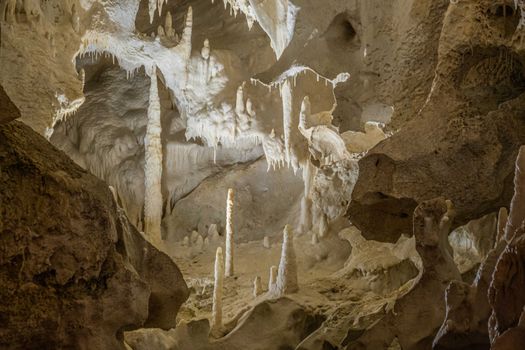
If Jules Verne had designed an amusement park, it would look like Postojna. Spanning over 24 kilometers of carved karst passages, this Slovenian icon houses a 140-year-old double-track underground railway. In under three hours, you can journey deep into massive chambers filled with stark-white calcified columns and delicate "spaghetti" stalactites.
The Speleological Highlight
Keep your eyes peeled in the subterranean vivarium for the Proteus anguinus—the blind, skin-colored salamander locally known as the "baby dragon." These aquatic troglobites can live up to 100 years and survive without food for up to a decade.
Pro-Tips for Visitors
* Avoid the midday crowds: Book the 9:00 AM or 3:30 PM train departures. Tour buses from Ljubljana flood the entrance between 11:00 AM and 2:00 PM.
* Dress for winter: The internal temperature remains locked at 50°F (10°C) year-round. Rent a heavy wool cape at the entrance ticket booth if you forget a thermal mid-layer.
---
2. Cuevas del Drach (Mallorca, Spain): Classical Music by Subterranean Lake
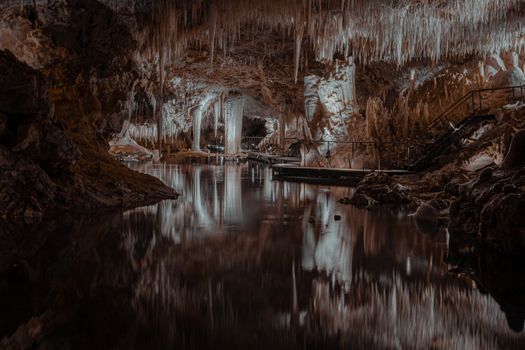
Located near Porto Cristo on the eastern side of Mallorca, the "Caves of Drach" (Dragon Caves) extend for nearly four kilometers and reach depths of 25 meters below the surface. Formed by Mediterranean seawater forcing its way through Miocene limestone, this system houses Lake Martel, one of the largest underground lakes in the world.
```
_____ _____
/ \ ~ ~ ~ ~ ~ ~ / \
_/ \_ (Lake Martel) _/ \_
|_____________|==============|_____________|
|| ||
[Stalactites] [String Quartet]
```
The Sensory Highlight
At the conclusion of the 1-hour guided walking tour, visitors take a seat in a natural amphitheater overlooking Lake Martel. The ambient lights drop into total blackout before four softly illuminated wooden boats glide across the crystal-clear water, carrying a live string quartet performing works by Chopin and Offenbach.
Pro-Tips for Visitors
* The Exit Secret: After the concert, skip the long line for the return footbridge. Instead, join the shorter queue on the right-hand pier to ride out across Lake Martel inside one of the small wooden rowing boats—it is included in your standard ticket price.
* Photography Rule: No flash photography or tripods are allowed inside, but handheld low-light photography is permitted during the walking portion (strictly prohibited during the concert).
---
3. Batu Caves (Selangor, Malaysia): Cathedral Caverns & Cultural Heritage
Rising dramatically just north of Kuala Lumpur, the Batu Caves system consists of a massive limestone outcrop estimated to be 400 million years old. Unlike the remote wilderness systems of Europe or North America, Batu is a vibrant, living Hindu shrine dedicated to Lord Murugan, whose golden 140-foot statue guards the base.
```
/ \ [272 Rainbow Steps]
/ \ ---------------------
/ | \ | Red | Orange | Yellow |
/ | \ ---------------------
/____|____\ ||
|| [Cathedral Cave]
```
The Cultural Highlight
Reaching the main "Cathedral Cave" requires ascending 272 steeply pitched, rainbow-painted steps while dodging long-tailed macaque monkeys. Once inside, you enter a cavern with ceilings soaring over 300 feet high, punctured by natural skylights that cast dramatic sunbeams onto ancient shrines.
Pro-Tips for Visitors
* The Hidden Speleology Route: While the main temple cave takes under an hour, book a secondary 45-minute tour of the adjacent Dark Cave through local conservation societies to see rare trapdoor spiders and ancient rock formations.
* Dress Code strictly enforced: Shoulders and knees must be covered. You can rent a sarong at the bottom of the steps for around 5 MYR (~$1 USD) if your attire doesn't comply.
---
4. Harrison’s Cave (Barbados): Crystalline Waterfalls by Tram
While Barbados is famed for its white-sand coastline, its interior is built entirely of porous, calcified coral limestone. Harrison's Cave is a active, flowing cave system featuring crystal-clear streams, cascading waterfalls, and deep emerald pools formed by subterranean spring water.
```
~~~~~~~~~~~~~~~~~~~~~~~~~~~~~~~~~ <-- Surface Sun
\ /
\ [Electric Tram Path] /
\===== O====O =======/
| (Speleothems) |
| Dripstones |
|~~~~~~~~~~~~~~~~~~| <-- Emerald Pools
```
The Underground Experience
Rather than navigating uneven footpaths, visitors board an open-air, low-emission electric tram that wind down through towering corridors. You will disembark at key points, such as the "Rotunda Room" and the "Great Hall," to walk right up to glass-like mirror pools fed by underground rivers.
Pro-Tips for Visitors
* Choose the Walk-In Eco-Tour: If riding in a tram feels too passive, book the afternoon Eco-Adventure Tour. You will be outfitted with a helmet and headlamp to trek through unlit portions of the cave system on foot.
* Hydration: Humidity inside Harrison's Cave hovers around 85-90%. Carry a refillable insulated water bottle.
---
5. Mammoth Cave: Domes and Dripstones Trail (Kentucky, USA)
Mammoth Cave holds the title of the longest known cave system in the world, with over 426 miles of surveyed passages. While tackling the entire system takes weeks, the Park Service offers tailored afternoon routes. The Domes and Dripstones Tour compresses the best geological highlights into a 2-hour, 0.75-mile trip.
```
[Surface Sinkhole]
|
(280 Stair Steps)
|
v
+-------------------------------------+
| Domes & Shafts (Vertical Karst) |
+-------------------------------------+
|
v
+-------------------------------------+
| Frozen Niagara (Flowstone Wall) |
+-------------------------------------+
```
Geological Marvels
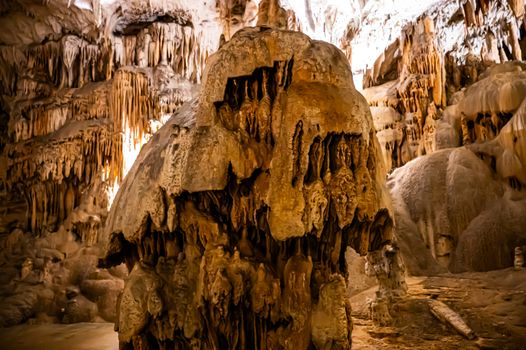
This route takes you down a series of tight, vertical shafts into soaring domes carved by falling acidic water, ending at the iconic Frozen Niagara—a massive, 75-foot cascade of petrified flowstone that looks like a frozen waterfall.
Pro-Tips for Visitors
* Reserve 60 days early: National Park Service tour slots sell out fast. Lock in your timing at Recreation.gov two months prior to your travel date.
* Footwear selection: Wear sticky-soled hiking shoes; the wet limestone stairs can be surprisingly slick, especially on the descent into the initial shafts.
---
6. Ruakuri Cave (Waitomo, New Zealand): Bioluminescent Glowworm Sanctum
While nearby Waitomo Glowworm Cave limits visits to short boat rides, Ruakuri Cave offers New Zealand’s longest guided underground experience (approx. 2 hours). It features a spiraling, barrier-free concrete ramp that descends into a roaring subterranean canyon filled with hidden waterfalls and Arachnocampa luminosa—New Zealand's famous glowworms.
```
. * . * . * . *
* [Bioluminescent Ceiling] .
. * . * . * . *
=================================
| Spiral Concrete Descent Ramp |
=================================
||
(Underground River)
```
The Sensory Highlight
At the deepest point of the walk, your guide will ask everyone to turn off their flashlights. Above your head, thousands of tiny bioluminescent larvae emit a soft, starry, cobalt-blue light across the dark cave ceiling, illuminating the ancient flowstone columns like a living planetarium.
Pro-Tips for Visitors
* Photography Heaven: Unlike the standard Waitomo Cave, Ruakuri permits tripod-free low-light photography throughout the entire tour. Set your camera ISO to 3200-6400 with a wide aperture ($f/1.8 - f/2.8$) for handheld glowworm shots.
* Accessibility: Ruakuri is 100% wheelchair-accessible thanks to its engineering design, making it the premier option for travelers with mobility needs.
---
Quick Logistics & Budget Comparison Table
| Cave System & Location | Cost Range (USD) | Tour Duration | Internal Temp | Difficulty Level | Transit Access from Major Hub |
| :--- | :--- | :--- | :--- | :--- | :--- |
| Postojna Cave (Slovenia) | $32 – $45 | 1.5 - 2 Hours | 50°F (10°C) | Easy (Train/Flat walk) | 45-min drive or bus from Ljubljana |
| Cuevas del Drach (Mallorca) | $18 – $22 | 1 Hour | 64°F (18°C) | Easy-Moderate (Stairs) | 1-hour drive or public bus from Palma |
| Batu Caves (Malaysia) | Free – $8 | 1.5 - 2.5 Hours | 82°F (28°C) | Moderate (272 steep steps) | 20-min ride via KTM Komuter train from KL Sentral |
| Harrison's Cave (Barbados) | $30 – $60 | 1.5 Hours | 80°F (27°C) | Very Easy (Tram tour) | 30-min taxi or public bus from Bridgetown |
| Mammoth Cave (USA) | $20 – $26 | 2 Hours | 54°F (12°C) | Moderate (280+ stairs) | 1.5-hour drive from Louisville or Nashville |
| Ruakuri Cave (New Zealand)| $55 – $65 | 2 Hours | 54°F (12°C) | Easy (Accessible ramps) | 2.5-hour drive from Auckland |
---
Subterranean Travel Checklist: What to Pack for an Afternoon Cave Tour
Before heading into the earth’s crust for a half-day excursion, pack these essentials inside a small 15L-20L daypack:
- A Packable Layer: Cave microclimates remain stable regardless of external weather. A lightweight packable down jacket or fleece sweater is crucial for ambient temperatures of 50–55°F.
- Grippy, Closed-Toe Footwear: Speleothems are coated in a thin film of water and minerals ("cave bacon" and flowstone are notoriously slick). Ditch sandals for shoes with sticky rubber outsoles.
- Hands-Free Illumination: While show caves are lit with LED pathways, carrying a compact 300+ lumen headlamp inside your bag provides extra peace of mind along darker stretches.
- Dry Bag / Phone Case: High internal humidity causes ambient condensation on glass lenses. A small microfiber cloth and water-resistant sleeve will protect electronics from dripping stalactites.
- Motion Sickness Remedies: If visiting cave systems accessed via subterranean boats or trains (like Postojna or Waitomo), prone travelers may benefit from a quick anti-nausea remedy.
---
Final Thoughts: Finding Wonder Beneath the Surface
Exploring the world's underground networks doesn’t require weeks of preparation or extreme mountaineering experience. By choosing accessible, half-day systems, you can witness millions of years of geological art, unique troglobitic life, and breathtaking mineral formations—all while leaving plenty of daylight to enjoy a local meal on the surface. Add one of these afternoon cave trips to your itinerary, strap on a fleece layer, and step into the depths.
---